
What Is Psychological Testing? Types And What To Expect
When a doctor suspects a physical condition, they order blood tests or imaging. But how do mental health professionals assess what's happening in the mind? If you've been wondering what is psychological testing and whether it might benefit you or someone you care about, you're asking an important question.
Psychological assessments go far beyond a simple conversation. They use standardized tools and clinical interviews to measure cognitive abilities, emotional functioning, personality traits, and behavior patterns. The results give clinicians concrete data to make accurate diagnoses, rule out other conditions, and build targeted treatment plans.
At New Path Counseling, we conduct comprehensive psychological evaluations for children, teens, and adults at our Gretna and Omaha locations. This guide covers the different types of assessments available, what happens during an evaluation, and how testing can provide clarity when you need answers about mental health.
Why psychological testing matters
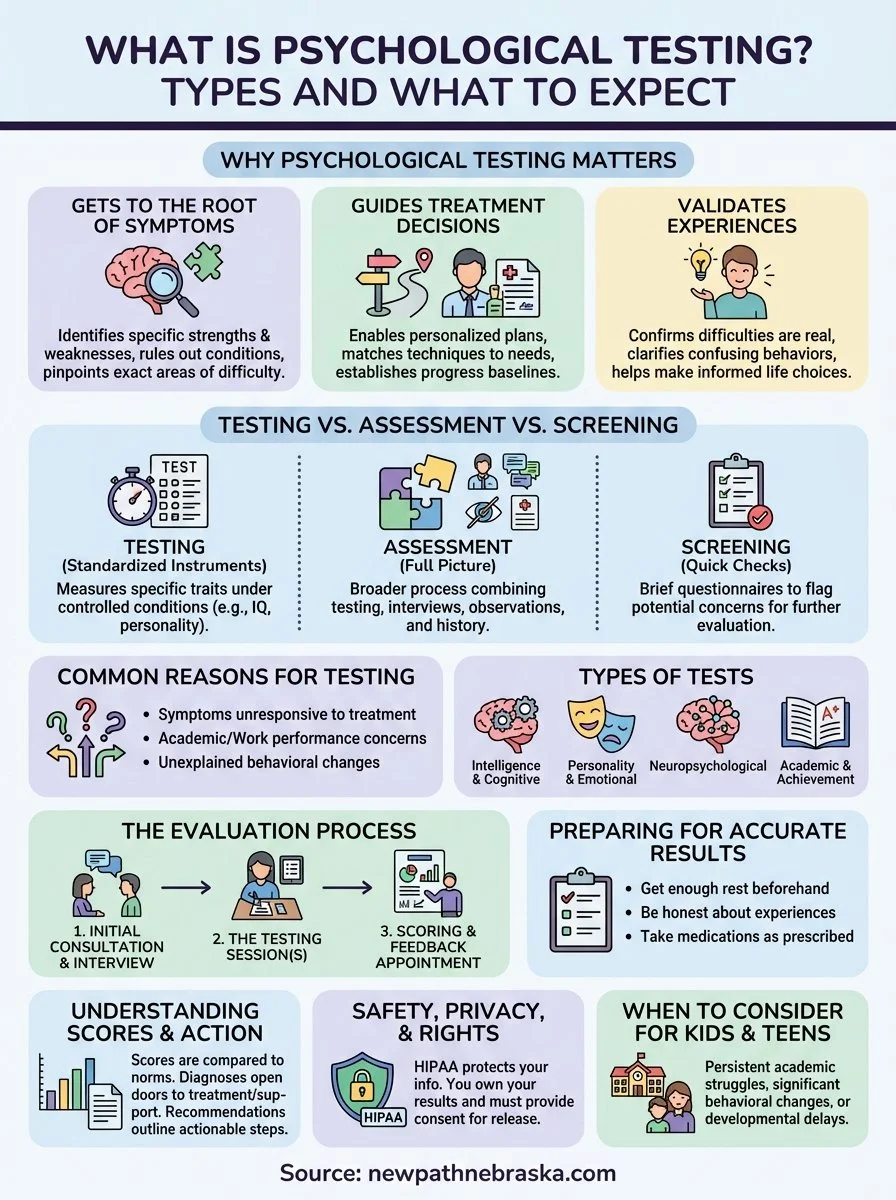
You've likely noticed patterns in how you think, feel, or behave that don't quite add up. Maybe concentration has become harder, relationships feel strained, or emotions swing unpredictably. Psychological testing offers concrete evidence about what's happening beneath the surface, replacing guesswork with measurable data that guides your path forward.
Gets to the root of symptoms
Many mental health conditions share overlapping symptoms, making diagnosis challenging through conversation alone. Testing reveals specific cognitive strengths and weaknesses, distinguishes between similar disorders, and identifies co-occurring conditions that might complicate treatment. For example, what looks like attention problems could stem from anxiety, a learning disability, or actual ADHD, and the differences matter tremendously for effective care.
Results pinpoint exact areas of difficulty rather than relying on general observations. If you've struggled for years without clear answers about what is psychological testing can finally provide, these assessments offer objective measurements of memory, processing speed, emotional regulation, and executive function. That specificity transforms vague concerns into actionable information.
"Psychological testing removes the guesswork from diagnosis by providing standardized, objective data about how your mind works."
Guides treatment decisions
Your clinician uses test results to build apersonalized treatment plan matched to your actual needs rather than trial-and-error approaches. The data shows which therapeutic techniques will likely work best, whether medication might help, and what accommodations could support you at school or work. This targeted approach saves time and reduces frustration compared to generic interventions.
Testing also establishes a baseline for measuring progress over time. When you retake assessments after treatment, clinicians can document concrete improvements in areas like attention span, emotional stability, or cognitive flexibility. Insurance companies often require this documentation to approve ongoing coverage, and schools need it to provide educational support services.
Validates your experiences
Struggling without understanding why takes an emotional toll. Testing confirms that your difficulties are real and not character flaws or laziness. Many people feel profound relief when results explain long-standing challenges, whether those involve learning, mood regulation, or social functioning. That validation alone can shift how you view yourself and your capabilities.
Families benefit too when testing clarifies confusing behaviors in children or teens. Parents often blame themselves when kids struggle academically or socially, but assessment results reveal neurological or developmental factors beyond anyone's control. Armed with accurate information, you can advocate effectively for needed resources and adjust expectations to match realistic abilities rather than feeling perpetually disappointed.
Understanding your unique cognitive and emotional profile also helps you make informed decisions about education, career paths, and lifestyle choices. If testing reveals strong visual-spatial skills but weak verbal processing, for instance, you might choose fields that play to those strengths. Results empower you to build on what works well rather than fighting against how your brain naturally operates.
Psychological testing vs assessment and screening
People often use these terms interchangeably, but they describe different levels of evaluation. Understanding the distinctions helps you knowwhat to expect when a clinician suggests one approach over another. Each serves a specific purpose in identifying and addressing mental health concerns, and you might experience all three at different points in your care journey.
Testing targets specific traits
Psychological tests are standardized instruments that measure particular aspects of functioning. These tools use consistent administration procedures, scoring methods, and comparison norms to evaluate intelligence, memory, personality traits, or specific symptoms. When someone asks what is psychological testing, they're usually referring to these structured measurements that produce numerical scores or diagnostic profiles.
You'll complete these tests under controlled conditions with specific time limits and instructions. Examples include IQ tests that measure cognitive abilities, personality inventories that assess emotional patterns, or achievement tests that gauge academic skills. Clinicians select tests based on the precise questions they need answered about your functioning.
Assessment creates the full picture
Psychological assessment encompasses a broader evaluation process that includes multiple components beyond formal testing. Your clinician combines test results with clinical interviews, behavioral observations, medical history, and information from family members or teachers. This comprehensive approach builds a complete understanding of your situation rather than relying on test scores alone.
"Assessment is the process, testing is one of the tools used within that process to gather objective data."
The assessment process typically takes several sessions as your clinician gathers information from various sources and perspectives. They interpret test scores within the context of your life circumstances, developmental history, and presenting concerns. This holistic view prevents misdiagnosis and ensures recommendations address your actual needs rather than isolated symptoms.
Screening identifies possible concerns
Screening tools offer quick checks for potential problems that warrant further investigation. These brief questionnaires or checklists help clinicians decide whether you need comprehensive assessment or testing. Schools use screening to identify students who might benefit from additional support, while primary care doctors screen for depression or anxiety during routine appointments.
Screening produces less detailed information than formal testing. You might complete a short form that takes minutes rather than hours, and results indicate risk levels instead of precise diagnoses. Positive screening results don't confirm a condition but signal that deeper evaluation makes sense given your symptoms or circumstances.
Common reasons clinicians recommend testing
Clinicians suggest psychological testing when they need objective data to answer specific questions about your mental health or cognitive functioning. While therapy helps many people, testing becomes necessary when symptoms remain unclear, treatment isn't working, or you need documentation for accommodations. These assessments fill critical gaps that conversation alone can't address.
When symptoms don't respond to treatment
You've tried therapy or medication for months without meaningful improvement, which signals that your clinician may have missed something important in the initial diagnosis. Testing reveals whether you're dealing with co-occurring conditions, underlying learning disabilities, or misdiagnosed disorders that require different treatment approaches. For instance, someone treated for depression might actually have bipolar disorder or ADHD, and the wrong intervention makes symptoms worse rather than better.
"Testing becomes essential when standard treatments fail, revealing hidden factors that explain why initial approaches didn't work."
Academic or work performance concerns
Your grades have dropped suddenly, you miss deadlines despite sincere effort, or job tasks feel impossibly difficult compared to colleagues. These struggles often prompt testing referrals because they suggest cognitive or processing differences that affect your ability to perform. Assessments identify specific learning disabilities, attention deficits, or memory problems that explain the gap between your intelligence and your actual output.
Employers and schools typically require formal documentation before providing accommodations like extended test time, modified assignments, or workplace adjustments. Testing gives you the evidence needed to access these supports legally through ADA provisions or educational plans. Understanding what is psychological testing accomplishes in these situations helps you see why clinicians consider it a practical necessity rather than an optional extra.
Behavioral changes need explanation
Something has shifted noticeably in how you or your child functions, whether that involves mood swings, social withdrawal, increased impulsivity, or cognitive decline. Testing helps distinguish between temporary stress responses and developing mental health conditions that require intervention. Your clinician uses results to determine if these changes stem from trauma, neurological issues, developmental disorders, or treatable psychiatric conditions.
Family members often notice changes that you might not recognize yourself, particularly with conditions like early dementia, bipolar disorder, or personality changes following head injuries. Testing provides concrete evidence of cognitive or emotional changes over time, creating a baseline for monitoring progression or measuring treatment effectiveness. This documentation proves especially valuable when you need to make difficult decisions about care levels or legal capacity.
Types of psychological tests you might take
Clinicians select from dozens ofstandardized assessment tools depending on what questions need answers about your functioning. Each test type measures different aspects of cognition, personality, or behavior, and you'll likely complete several instruments during a comprehensive evaluation. Understanding the main categories helps you know what to expect when exploring what is psychological testing can reveal about your specific situation.
Intelligence and cognitive tests
These assessments measure your intellectual abilities and problem-solving skills across various domains. The most common tools include the Wechsler Adult Intelligence Scale (WAIS)for adults or the Wechsler Intelligence Scale for Children (WISC) for younger populations. You'll work through tasks involving verbal reasoning, visual puzzles, memory challenges, and processing speed exercises that reveal your cognitive strengths and weaknesses rather than producing a single IQ number.
Clinicians use results to identify learning disabilities, intellectual disabilities, or giftedness. The scores show whether you process information differently than expected for your age group, which explains difficulties in school, work, or daily tasks that require mental flexibility and abstract thinking.
Personality and emotional assessments
Personality inventories like the Minnesota Multiphasic Personality Inventory (MMPI) or Myers-Briggs Type Indicator assess your emotional patterns, coping styles, and interpersonal tendencies. You'll answer hundreds of questions about your thoughts, feelings, and behaviors, and the results create a profile of your psychological makeup. These tools help clinicians diagnose mood disorders, personality disorders, or trauma-related conditions that affect how you interact with the world.
"Personality assessments reveal consistent patterns in how you think and feel, distinguishing temporary stress from underlying psychological conditions."
Projective tests like the Rorschach inkblot test ask you to interpret ambiguous images, revealing unconscious thoughts and emotional conflicts that structured questionnaires might miss.
Neuropsychological evaluations
These specialized assessments examine brain function and cognitive processing in detail, measuring memory, attention, language skills, visual-spatial abilities, and executive functioning. Clinicians recommend neuropsychological testing when they suspect brain injury, stroke, dementia, or neurological conditions affecting your mental abilities. The results pinpoint which brain systems work well and which need support or rehabilitation.
Academic and achievement testing
Educational assessments measure your actual knowledge and skills in reading, writing, mathematics, and other academic areas. Clinicians compare your achievement scores to your cognitive abilities to identify specific learning disabilities where performance falls significantly below your potential. Schools require this documentation to provide individualized education plans and specialized instruction that addresses your learning differences.
What the evaluation process looks like
Walking into a psychological evaluation feels less intimidating when you know what actually happens during each appointment. Most comprehensive assessments unfold across two to four sessions spanning several hours total, though the exact timeline depends on what your clinician needs to measure. Understanding what is psychological testing involves in practical terms helps you arrive prepared and relaxed rather than anxious about the unknown.
Initial consultation and interview
Your clinician begins with a detailed conversation about your concerns, medical history, family background, and current symptoms. This clinical interview typically lasts 60 to 90 minutes and covers developmental milestones, educational experiences, relationship patterns, and previous mental health treatment. You'll discuss what prompted the evaluation and what questions you hope the testing will answer, giving your clinician direction for selecting appropriate assessment tools.
Bring any relevant records like previous test results, report cards, medical documents, or lists of current medications to this first session. Your clinician may ask you tocomplete questionnaires beforehand or send forms to family members, teachers, or other people who observe your functioning in different settings. This background information shapes how they interpret your test performance later.
The testing session itself
You'll spend several hours completing the actual psychological tests, usually in one sitting or split across multiple appointments depending on your stamina and the battery of instruments your clinician selected. The environment stays quiet and distraction-free while you work through tasks that might include solving puzzles, answering personality questions, remembering number sequences, or interpreting images. Your clinician observes not just your answers but also how you approach problems, how quickly you work, and whether you show signs of frustration or fatigue.
"Testing sessions measure both your final scores and your problem-solving strategies, giving clinicians insight into how your mind processes information."
Scoring and feedback appointment
After the testing concludes, your clinician needs one to two weeks to score instruments, analyze results, and prepare a comprehensive written report. You'll return for a feedback session where they explain your scores, discuss diagnostic impressions, and outline treatment recommendations. This appointment gives you time to ask questions about findings and understand what the numbers mean for your daily life, whether that involvestherapy referrals, medication consultations, or accommodations at school or work.
How to prepare and get the most accurate results
Accurate test results depend partly on your physical and mental state during the evaluation. While clinicians design these instruments to measure your typical functioning, certain factors can skew scores and lead to misleading conclusions about your abilities or symptoms. Taking a few practical steps before your appointment ensures the data reflects your actual cognitive and emotional patterns rather than temporary circumstances.
Get enough rest beforehand
Schedule your testing session for a time when you typically feel alert and focused rather than exhausted or drowsy. Lack of sleep directly impairs memory, attention, processing speed, and problem-solving abilities, which means your scores won't represent your true capabilities if you arrive sleep-deprived. Most clinicians recommend getting at least seven to eight hours of quality sleep the night before testing to perform at your baseline level.
Avoid staying up late cramming or worrying about the evaluation itself. Testing measures how you naturally function, not how well you can prepare, so anxiety about performance only interferes with accurate results. Your clinician wants to see your typical patterns, including areas where you struggle, because that information guides effective treatment planning.
Be honest about your experiences
Answer all questions truthfully rather than trying to appear better or worse than you actually feel. Some people minimize symptoms out of embarrassment while others exaggerate difficulties hoping for specific diagnoses or accommodations. Either approach produces inaccurate results that lead to inappropriate treatment recommendations or missed conditions that need attention.
"Psychological testing only works when you provide honest responses, allowing clinicians to see your actual functioning rather than a manufactured presentation."
Your clinician has encountered every type of symptom and struggle imaginable, so judgment isn't part of the evaluation process. They're gathering objective data to help you, and that requires seeing the complete picture of your experiences.
Take medications as prescribed
Continue your regular medication schedule unless your doctor specifically instructs otherwise. Suddenly stopping psychiatric medications before testing can trigger withdrawal symptoms or symptom rebounds that distort results. Your clinician needs to understand how you function with your current treatment regimen rather than in an artificial unmedicated state, especially when the goal involves adjusting those treatments based on test findings.
Inform your clinician about all medications and supplements you take, including over-the-counter products. Some substances affect cognitive performance or mood in ways that matter for interpreting your scores within the proper context.
Understanding scores, diagnosis, and recommendations
Once your clinician completes scoring, you'll receive a detailed written report explaining what the numbers mean and how they translate into practical next steps. This document becomes a roadmap for treatment, educational planning, and workplace accommodations, but the technical language can feel overwhelming at first. Learning how to read and use your results helps you make informed decisions about your care rather than feeling confused by percentiles and diagnostic codes.
How clinicians interpret your numbers
Your test scores get compared to normative data from thousands of people in your age group who took the same assessment. Most psychological tests report results as percentile ranks rather than raw scores, showing where you fall relative to others. If you score at the 75th percentile on memory tasks, you performed better than 75 percent of people your age, while a 25th percentile score means 75 percent scored higher than you did.
Clinicians look for patterns across different scores rather than fixating on single numbers. They identify significant gaps between your abilities in different areas, like strong verbal skills paired with weak visual processing, which suggests specific learning differences requiring targeted intervention. Understanding what is psychological testing reveals through these patterns helps you see why certain tasks feel effortless while others demand excessive mental effort despite your intelligence.
"Test scores gain meaning through comparison and context, revealing your unique cognitive profile rather than labeling you with a single number."
What does a diagnosis actually tell you
Your clinician uses test results alongside clinical interviews and observations to determine whether you meet diagnostic criteria for specific mental health conditions. Diagnoses follow standardized classification systems like the DSM-5, which lists exact symptoms and severity levels required for each disorder. This formal diagnosis opens doors to treatment options, insurance coverage, and legal protections you might need at school or work.
Remember that diagnoses describe current functioning rather than permanent labels. Your symptoms may improve with treatment, and future testing could show different results as you develop new coping skills or as developmental changes occur. The diagnosis simply provides a common language that professionals use to communicate about your needs.
Turning findings into actionable steps
The most valuable part of your report outlines specific recommendations tailored to your results. Your clinician suggests therapy approaches that match your cognitive and emotional profile, whether that involves cognitive-behavioral therapy, medication consultation, or specialized interventions. They identify accommodations like extended test time, note-taking assistance, or modified work schedules that compensate for areas where you struggle.
Schools and employers require this documentation to provide formal support services under ADA or IDEA provisions. You'll use these recommendations to advocate for yourself, explaining exactly what helps you perform at your best rather than making vague requests for assistance.
Safety, privacy, and your rights
Psychological testing involves sharing sensitive information about your mental health, cognitive abilities, and personal experiences, which makes understanding your legal protections crucial before you begin. Federal and state laws regulate how clinicians collect, store, and share your test results, and you hold specific rights throughout the evaluation process. Knowing these protections helps you participate confidently while ensuring your personal information stays secure.
HIPAA protections guard your information
Your psychological test results fall under Health Insurance Portability and Accountability Act protections, which means clinicians must keep all findings confidential unless you provide written permission for release. Testing centers implement secure storage systems for both paper files and electronic records, limiting access to only the professionals directly involved in your care. Your clinician cannot share results with employers, schools, family members, or other providers without your explicit consent through signed authorization forms that specify exactly what information goes where.
"HIPAA regulations ensure your psychological testing data remains private unless you choose to share it with specific individuals or organizations."
Exceptions to confidentiality exist only when safety concerns arise, such as when testing reveals you pose an immediate danger to yourself or others, or when courts issue legal orders for records. Your clinician must inform you of these limitations before testing begins, so you understand exactly when they might need to break confidentiality to protect you or others.
Who can access your results
You own your psychological test results and can request copies of all reports, scores, and clinician notes at any time. However, clinicians often provide interpreted summaries rather than raw test materials because scores require professional context to avoid misunderstanding. Parents typically access their minor children's full results until age 18, though state laws vary on when teenagers gain independent decision-making rights regarding their mental health information.
Your right to informed consent
Before any testing begins, your clinician must explain what is psychological testing will involve, how long sessions take, what the assessments measure, and how they'll use your results. You can ask questions, decline specific tests, or stop the evaluation at any point without penalty or judgment. This informed consent process protects you from unwanted procedures while ensuring you understand both the benefits and limitations of the assessment you're considering.
When to consider testing for kids and teens
Children and adolescents experience rapid developmental changes that make distinguishing between typical growing pains and actual psychological concerns challenging. You might wonder whether your child's struggles at school, emotional outbursts, or social difficulties signal a deeper issue requiring professional evaluation. Psychological testing becomes valuable when behaviors persist despite your best parenting efforts or when symptoms interfere significantly with your child's ability to function at home, school, or with peers.
Academic struggles that persist
Your child works hard but still brings home failing grades, completes homework but forgets to turn it in, or reads the same paragraph repeatedly without comprehension. These patterns suggest learning disabilities or attention disorders rather than laziness or lack of motivation. Testing identifies specific processing deficits that explain why traditional teaching methods don't work for your child, whether those involve dyslexia, dyscalculia, or auditory processing problems that make following verbal instructions difficult.
Schools often recommend evaluations when teachers notice a significant gap between ability and performance. Your bright child who struggles with writing assignments might have executive function deficits that make organizing thoughts onto paper nearly impossible. Understanding what is psychological testing reveals in these situations gives you concrete evidence to request accommodations like extended time, assistive technology, or specialized instruction through an individualized education plan.
"Testing moves children from frustration and failure to targeted support that matches their actual learning needs rather than continuing approaches that don't work."
Behavioral or emotional changes
Sudden shifts in mood, increased aggression, social withdrawal, or excessive anxiety signal that something has changed in your child's internal world. Testing helps distinguish between normal developmental phases and emerging mental health conditions like depression, anxiety disorders, or early trauma responses. Your clinician examines whether these behaviors stem from situational stress, neurological factors, or psychiatric conditions requiring immediate intervention rather than a wait-and-see approach.
Developmental concerns
Your toddler isn't meeting speech milestones, your preschooler struggles with social interactions, oryour teenager shows declining cognitive abilities that weren't present earlier. Early identification through psychological testing allows you to access therapies and supports when your child's brain shows the greatest capacity for change. Testing documents developmental delays, autism spectrum characteristics, or intellectual disabilities that qualify your child for early intervention services covered by insurance or state programs.
Where to go from here
You now understand what is psychological testing entails, from the different assessment types to the evaluation process and how results guide treatment decisions. This knowledge empowers you to make informed choices about whether testing might benefit you, your child, or someone you care about who struggles with unexplained cognitive, emotional, or behavioral challenges.
Taking the first step requires reaching out to qualified professionals who conduct comprehensive evaluations. AtNew Path Counseling, our clinicians provide psychological testing services for children, teens, and adults at both our Gretna and Omaha locations. We combine clinical expertise with a compassionate approach that recognizes how vulnerable you feel when seeking answers about mental health concerns.
Schedule a consultation to discuss your specific situation and determine whether psychological assessment makes sense for your needs. Testing provides the clarity and direction you deserve when symptoms persist, treatment stalls, or you need documentation for accommodations. Contact us today to begin your path toward understanding and effective support.